

ECSS NextGen project
ECSS NextGen project – Introduction
Building on more than 30 years of success, the European Cooperation for Space Standardization (ECSS) is now focusing on preparing for the next decades with the launch of the ECSS NextGen Project. The Project goal is to develop a modern, agile, and digital updated ECSS system that will strengthen the European space ecosystem, support all European Industries and national agencies and maintain international cooperation.
A comparison of different standardization systems was carried out and the results were discussed by the ECSS Technical Authority and the ECSS Steering Board.
.png)
-1.png)
Figure 1 – comparison of different standardization systems
The separation of what/who/when – how – why content (as exampled by EASA in the comparison) has been established to simplify the use of ECSS. Requirements include what, who, and when, which are primarily used as contractual reference. Means of Compliance includes how, for use as benchmark approaches to support the compliance to requirements. Guidance material includes why, to support the application of ECSS in different use cases.
The ECSS NextGen WG has been established with participants from Space Agencies and Industry, including Large System Integrators, SMEs and Mid-Caps.
Figure 2 – ECSS NextGen WG members
The ECSS NEXTGEN WG has elaborated the following mission statement:
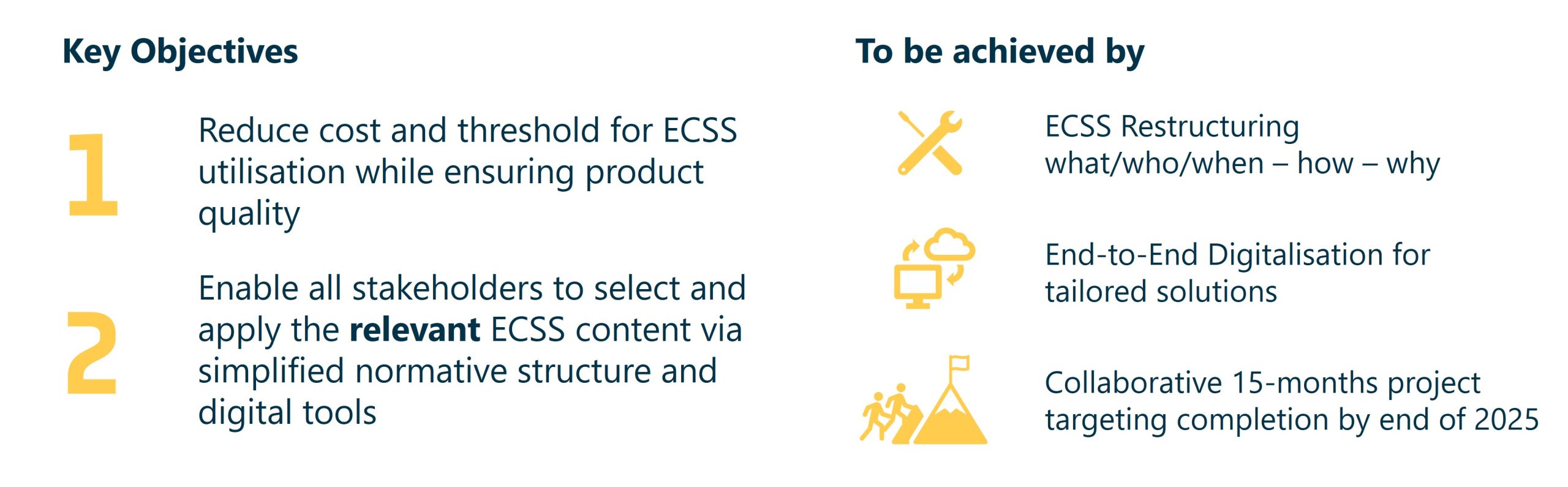
Figure 3 – Mission statement
The project follows a three-pillar approach:
1. ECSS issue D: a simplified version of the current system, categorising what/who/when and how.
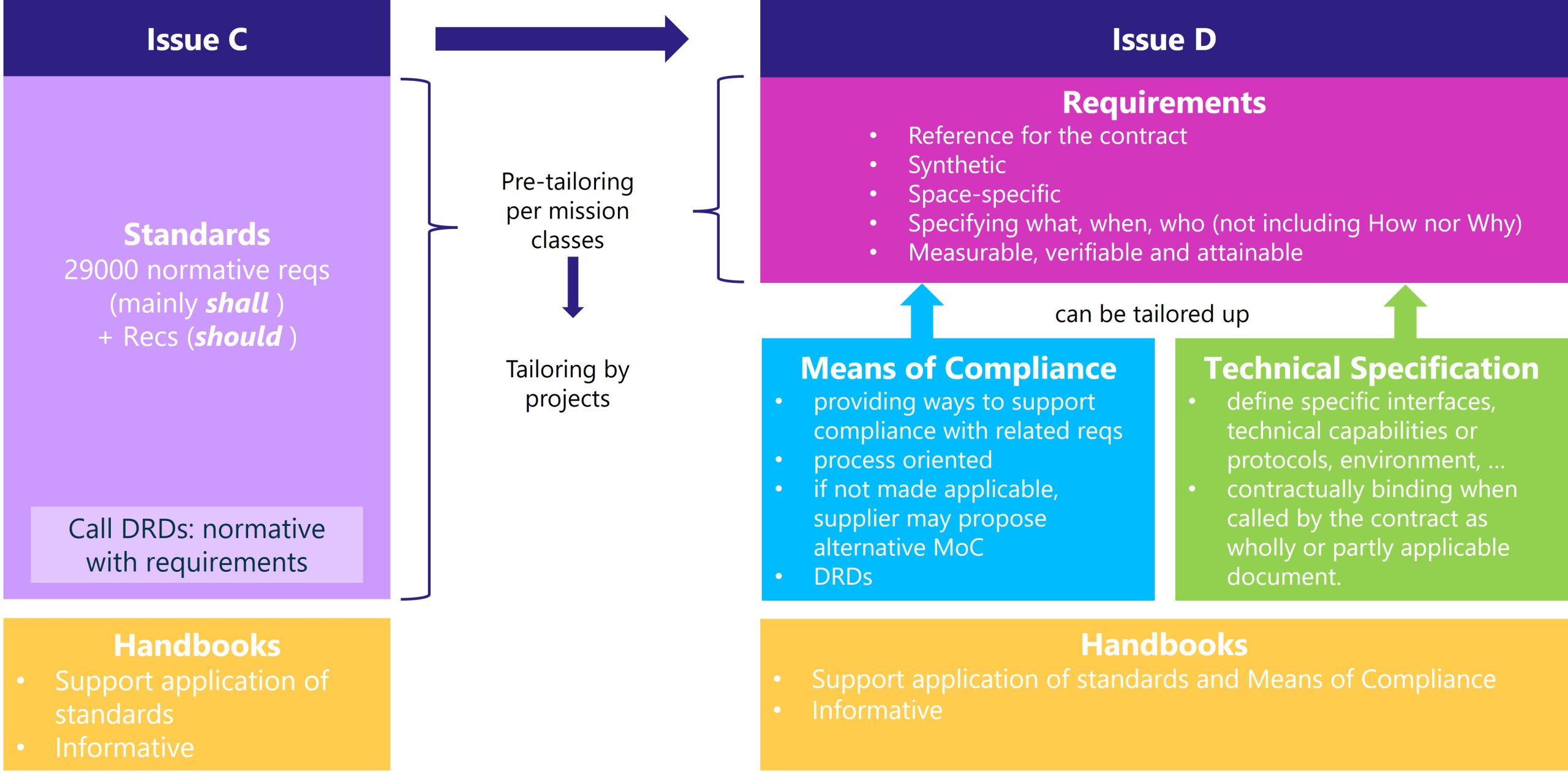
Figure 4 – ECSS re-structuring
2. Digitalisation: moving from document-based approach to a modern requirements database including AI/ML tools to support all users, enable efficient data management and digital exchange means with the end users (see below an overview of the ECSS Digitalisation timeline and the status on the 3rd of June 2026).
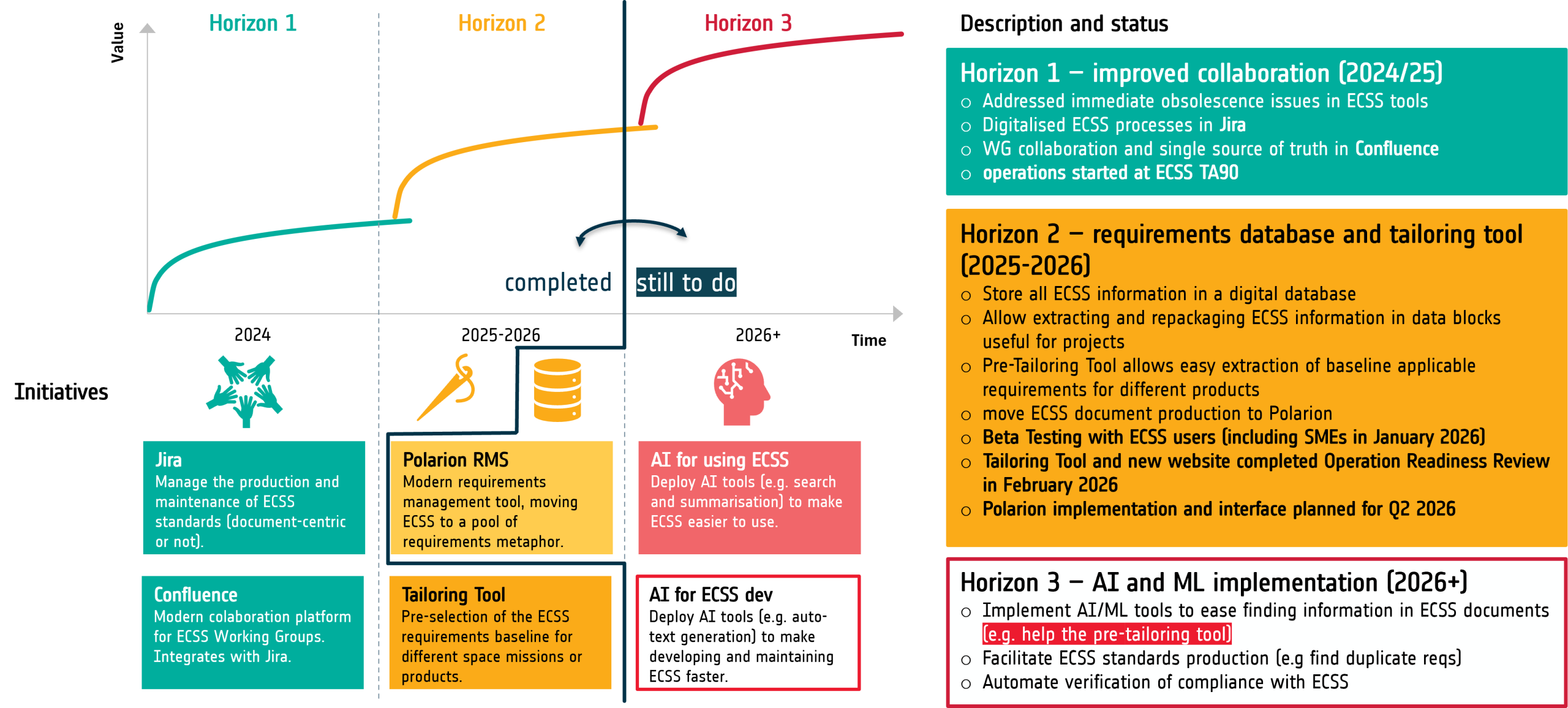
Figure 5 – digitalisation roadmap
3. Multidimensional Tailoring: providing a multi-dimensional project and product-specific tailoring tool for all stakeholders and procurement scenarios.
By the end of 2025, the ECSS NextGen WG had concluded the ECSS re-organization (see distribution of categories in Issue D below). The results were handed over to ECSS for document finalisation before submission for ECSS Technical Authority review and authorisation for publication (tbc), and subsequently ECSS Steering Board endorsement (tbc). After receiving the respective approvals, publication via the digital platform is anticipated in Q4 2026.
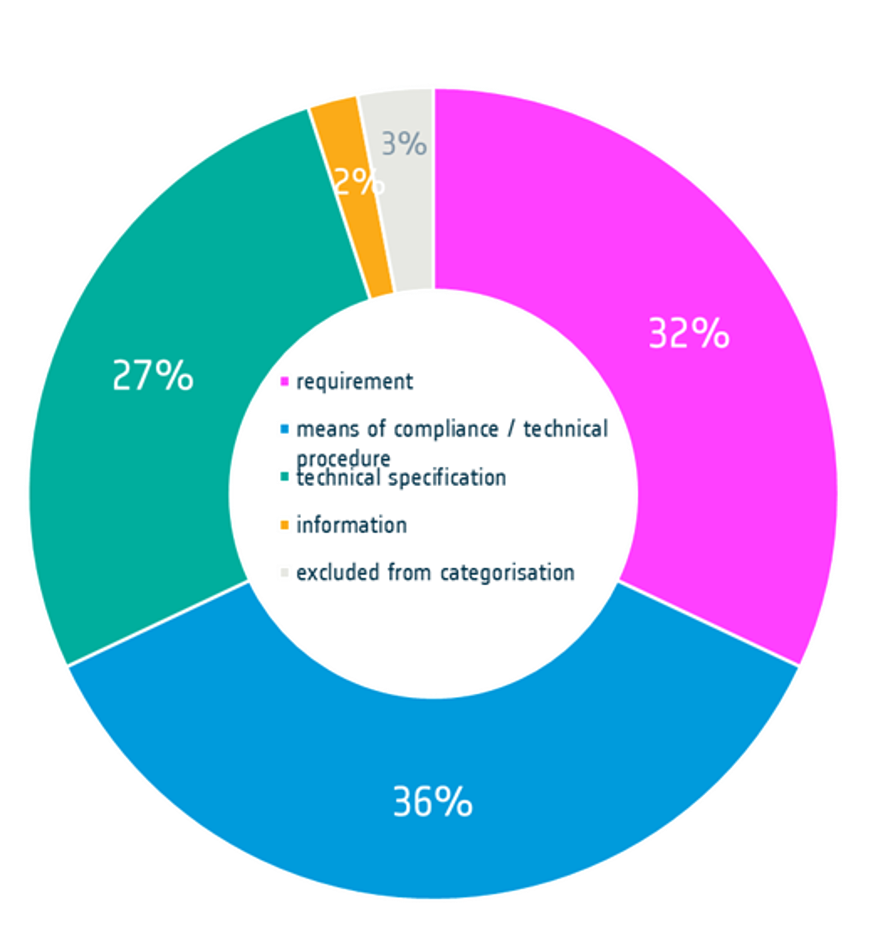
Figure 6 – distribution of categories in ECSS issue D
The Operational Readiness Review for the ECSS Digital Platform was concluded in December 2025. The responsibility for the activity was transferred to ECSS, with beta testing by the ECSS community completed by end of January 2026. Feedback from the ECSS community gathered during beta testing is currently being implemented into the Digital Platform, which is expected to be ready for Issue D content import by Q4 2026.
What should I do?
Release of Issue D will be accompanied by new guidance on how to use it, – remember, the re-organization and digitalisation is to help the user to select what is most appropriate for their purpose, no more or less.
–> Want to know more? –> E-mail the ECSS Secretariat and see our ECSS FAQ page.